Warm-up · greeting chain · 3 minutes
Greeting chain
In a circle. Greet the person next to you with a different greeting from the previous one. They reply and greet the next person. If you repeat, you're out.
1
Good morning!
2
Hi! How are you?
3
What's up?
4
Nice to see you!
Speaking Challenge 1 · Polite Greetings Roleplay · 1 min per situation
Tres situaciones, tres registros
Situation 1 · formal
You arrive at school and greet the principal.
Good morning, sir. How are you today?
Situation 2 · informal
You meet your best friend at break.
Hey! What's up?
Situation 3 · new
You meet a new student.
Hi, I'm… Nice to meet you!
Greeting → question → answer → goodbye. Four lines minimum. Then swap roles.
Phrases for your morning
Cinco pasos, cinco oraciones
First
First, I wake up at…
Then
Then I take a shower.
Next
Next, I brush my teeth.
After that
After that, I have breakfast.
Finally
Finally, I go to school.
First, then, next, after that, finally: the connectors. You will see more of them in week 7; today you just use them.
Modelo · 45 segundos
Sofía's morning steps
First
First, I wake up at six o'clock.
Then
Then I take a shower and I get dressed.
Next
Next, I brush my teeth.
After that
After that, I have breakfast with my mum. I always eat eggs.
Finally
Finally, I go to school by bus. That's my morning!
Modelo · 30 segundos
Mateo's morning steps
First
First, I wake up at half past five.
Then
Then I wash my face and I make my bed.
Next
Next, I have breakfast: fruit and eggs.
Finally
Finally, I go to school. Bye!
Pronunciation · repeat three times
Listen and repeat
«First»: /fɜːrst/. Pause after the comma.
«Then» with a voiced th: /ðen/.
«Next»: /nekst/. Cuatro consonantes seguidas.
«After that»: /ˈæftər ðæt/.
FI-nal-ly: acento al inicio.
Finish with energy.
Rubric · this is how it should sound
Four things, five points each
| Criterion | 5 · Top | 3 · Basic | 1 · Low |
|---|---|---|---|
| Steps | Five steps with five connectors. | Three steps. | One or two. |
| Verbs | Correct verbs, no -s with I. | One or two mistakes. | Verbs in Spanish or made up. |
| Pronunciation | Everything is understood. | Most of it is understood. | Hard to understand. |
| Fluency | Sin leer, sin parar. | Looks at the notebook sometimes. | Reads everything. |
Preparation · 3 minutes
Choose five sentences from your workshop
1
First, I…
2
Then, I…
3
Next, I…
4
After that, I…
5
Finally, I…
Put a connector in front of each one. Read them twice in a low voice. Close your notebook.
Speaking Challenge 2 · My Morning Steps · 45 s
My Morning Steps
Speaker: standing, notebook closed. Five steps with a connector. You can mime while you speak.
Listener: count the connectors on your fingers. At the end: one star, one wish.
Round 2 · in pairs · 45 s each
Now everyone speaks at once
Student A
Dice sus cinco pasos.
When the timer rings, stop.
Student B
Count the connectors.
One star, one wish. Then swap.
Peer feedback
Two stars and a wish
Stars
You used five connectors!
You used all five connectors!
Your verbs were correct.
Your verbs were right.
I understood everything.
I understood everything.
Wishes
Speak a little louder.
Speak a little louder.
Remember: I wake up, not wakes.
Remember: no -s with I.
Add the time: at six.
Add the time.
Level up · reading · A Morning in Tokyo
Hana is twelve and she lives in Tokyo. First, she wakes up at six and opens the window to check the weather. Then she has a traditional breakfast: rice, miso soup and fish. Next, she puts on her school uniform and packs her bag. After that, she walks to the train station with her neighbours; the train is always full, so they stand for twenty minutes. Finally, she arrives at school at eight and cleans her classroom with her classmates before the first lesson. In Japan, students, not cleaners, keep the school clean.
Level up · reading · 1 of 2
Why do Hana and her neighbours stand on the train?
ABecause they like standing
BBecause the train is crowded
CBecause the trip is short
DBecause they clean the train
Level up · reading · 2 of 2
What is surprising about Japanese schools, according to the text?
ALessons start at six
BStudents eat fish at school
CStudents clean the classroom
DThere are no uniforms
Match
Match the word with its meaning
First
Then
After that
Finally
pack my bag
crowded
the step that opens the routine
full of people
the last step
the step that comes right after
put my things in my backpack
later than the previous step
Fill in the gap
Complete each sentence
Finally
Then
Next
First
before
After that
, I wake up at six o'clock.
I take a shower and get dressed.
, I have breakfast with my family.
, I walk to the bus stop.
, I arrive at school at seven.
I brush my teeth I leave the house.
Video focus · look and speak
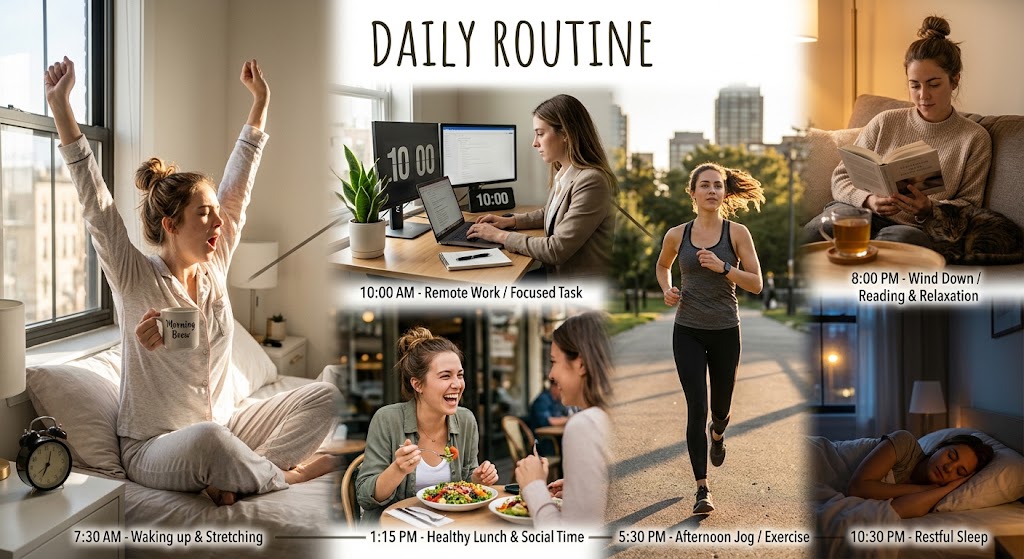
Read the times. Tell her day in order: first, then, after that, finally.
Video focus · situation
Two colleagues · the morning commute
N
Nora
What time do you usually get up?
I
Iván
Around six. First I take a shower, then I eat breakfast. After that, I commute by bus for forty minutes.
N
Nora
That's long! Where do you have lunch?
I
Iván
In the cafeteria. It's affordable and everyone goes there. Finally, I get off work at five and go home.
Now change the details and say it with a partner.
Find the mistake
Spot the error
Everyone go to the cafeteria at noon.
She eat breakfast at 7:00 every morning.
First I wake up, after I take a shower.
Fill in the gap
Complete with the video's key phrases
then
commute
After that
around
First
colleagues
, I wake up at 6:00 AM.
I take a shower, I eat breakfast.
, I go to school by bus.
I arrive at school 7:00 AM.
My takes forty minutes.
My mum has lunch with her in the cafeteria.
After learning
What you did today
You greeted people in three registers and told your morning in English, in five steps, without reading. That is speaking English.
On Friday: short reading Sofía's Day and the week's assessment. Bring Workshop 1.2.